Alan Llavore | Office of Marketing and Communications | (909) 537-5007 | allavore@csusb.edu
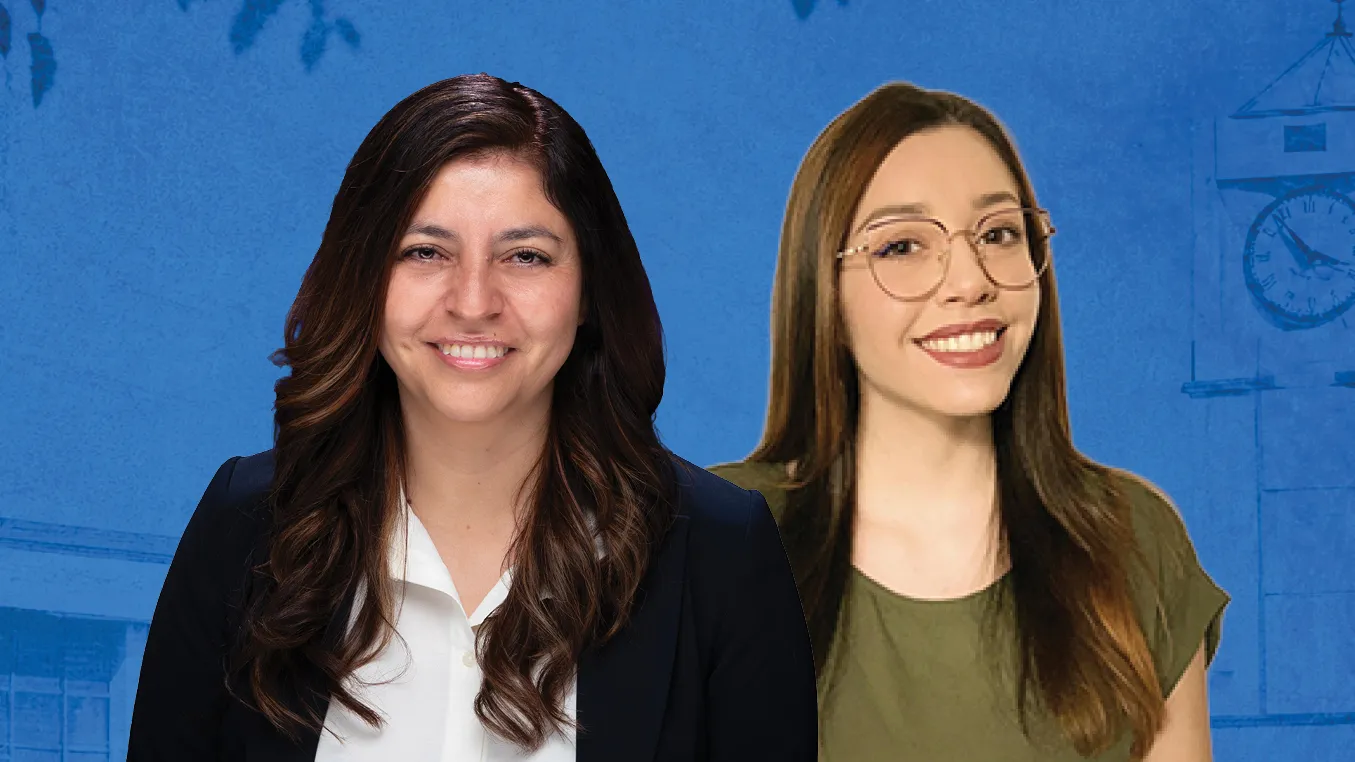
At a public university where many students are the first in their families to attend college, two graduates from California State University, San Bernardino’s Class of 2026 have distinguished themselves not only for academic achievement, but for how they have translated education into impact.
Carmen Uribe, a first-generation psychology student named the College of Social and Behavioral Sciences Outstanding Graduate Student, will be honored at the college’s Commencement ceremony at 1 p.m. Friday, May 15, at the Toyota Arena in Ontario. Uribe, who earned a master of arts, has built a research record that led to five peer-reviewed publications while examining mental health through both neuropsychological and sociocultural lenses. The Rialto resident’s work, conducted in collaboration with faculty mentors, has explored outcomes in Parkinson’s disease as well as psychosis within the Latinx community, reflecting a sustained focus on populations often underrepresented in clinical research.
Lidia Albarran, the Outstanding Undergraduate Student in social work who will graduate with a bachelor of science from the School of Social Work, will be honored at college’s the 6 p.m. May 15 ceremony, also at the Toyota Arena. Albarran has taken a different but equally grounded path – one rooted in direct service. A first-generation, nontraditional student balancing family responsibilities with full-time study, she has worked as a case manager intern helping students and families access basic resources, while also participating in community advocacy efforts addressing homelessness in San Bernardino.
Their stories, though distinct in method – one driven by research, the other by frontline service – are examples of how shared commitment to addressing inequities and expanding access, underscore CSUSB’s role in shaping careers tied closely to community need.
Uribe, a Rialto resident who plans to pursue a doctorate degree in psychology, said she chose to study in the field “because I was interested in understanding how people think, behave, and interact across diverse populations, as well as biopsychosocial factors that influence mental health and overall well-being. Over time, I began to see how psychological science provides a lens for understanding not only individual experiences, but also broader social patterns and long-term health outcomes.”
That led to her developing a strong interest the clinical side of the major, “where I could explore how research and practice can be used to better understand and support individuals facing mental health challenges.”
She counts as her academic mentors Jacob D. Jones and Maria M. Santos, both faculty members in the CSUSB Department of Psychology. With Jones, she became involved in research examining Parkinson’s disease. With Santos, Uribe’s research focused on individuals experiencing psychosis, including those in the Latinx community. She also credited Ismael Diaz, another faculty member of the psychology department, with helping her develop a deeper understanding and navigation of statistics.
“Through their mentorship, I continue to grow and advance as a student researcher,” Uribe said.
The research led to her involvement in multiple papers research published in peer-reviewed journals. “I feel that having the opportunity to coauthor this work has been meaningful because it reflects years of dedication, collaboration, and growth,” she said. “These projects focus on important issues such as mental health disparities and neuropsychological outcomes, which makes the work feel impactful to the real-world and valuable beyond the academic setting.”
Inspiring her to accomplish her goals are her parents, who she described as having endured many challenges. “Many of these challenges were often shaped by systemic barriers, limited resources, and not having access to the same opportunities I’ve had in higher education,” Uribe said. “Their resilience and perseverance, despite those circumstances, have had a lasting impact on me. I think a big part of what drives me is wanting to make them proud and to make the most of the opportunities they didn’t have. They continue to motivate me to pursue my goals with determination and to remain grounded in the value of hard work and persistence. I am deeply driven to use my education as a way to contribute meaningfully to the world.”
Her time at CSUSB has had an impact on helping her shape her future. “CSUSB has given me the opportunity to work closely with faculty, get involved in research labs, and really engage in hands-on experiences that have shaped my interests,” Uribe said. “The mentorship I’ve received here has played a big role in guiding me toward my career goals and helping me grow as both a student and researcher. I feel very lucky to be part of a community that genuinely supports its students and provides opportunities that have influenced the direction of my academic journey.”
Albarran, of Jurupa Valley, worked as a case manager intern for the Colton Joint Unified School District, helping students and their families connect with needed resources, a passion that she discovered through her church, where she and her husband established a food bank. “I chose social work because I believe that big changes start with small actions,” she said. “This work requires sacrifice, determination, and passion. Our communities need us. I believe that when you are passionate about something, you will always find a way to achieve it.”
That also included work in a community advocacy project with the city of San Bernardino in which she worked with a team to conduct a survey to understand what services the unhoused needed, and how those services could be delivered to them effectively.
Her service extends to other students through her work with the CSUSB College Corps, which is part of the state’s #CaliforniansForAll College Corps Program, a state service and career development program that provides students with financial support and professional experience while engaging in meaningful community service in education. Albarran tutors students who are new to the United States and whose first language is Spanish. “I help them believe in themselves and know they can achieve a higher education,” she said.
Her academic journey did not follow the traditional path of many other students. “I am a first-generation, non-traditional college student,” she said. “My journey to higher education began as an adult immigrant in the United States. I received my ESL (English-as-a-Second Language) certificate, completed my GED (general equivalency diploma) as a mother and low-income student, and then attended San Bernardino Valley College, where I earned my associate degree in sociology.”
Among the challenges she faced as she worked toward her degree was managing being a mother, a wife, a volunteer, two internships and her studies. “It is not easy to manage everything, but I am thankful because I have a wonderful family and counselors who support me,” Albarran said. “Also, as a social work student, I learned that self-care plays an important role in my life.”
CSUSB, she said, gave her the opportunity to learn, to gain work experience, build connections and friendships, and financial support to complete her degree. “I am very thankful to this institution for believing in me and opening the door, not only opening it, but also giving me the key to open many more doors, including opportunities for my children and future generations.”
Playing a big role in supporting her has been her husband, “the person who rides his bicycle 18 miles every single day, no matter the weather. Thank you to my husband who supports my dreams. Gracias, Marco Almaguer, por todo lo que haces por nosotros y por vivir este sueño conmigo (for everything you do for us and for living this dream with me).”