Alan Llavore | Office of Marketing and Communications | (909) 537-5007 | allavore@csusb.edu
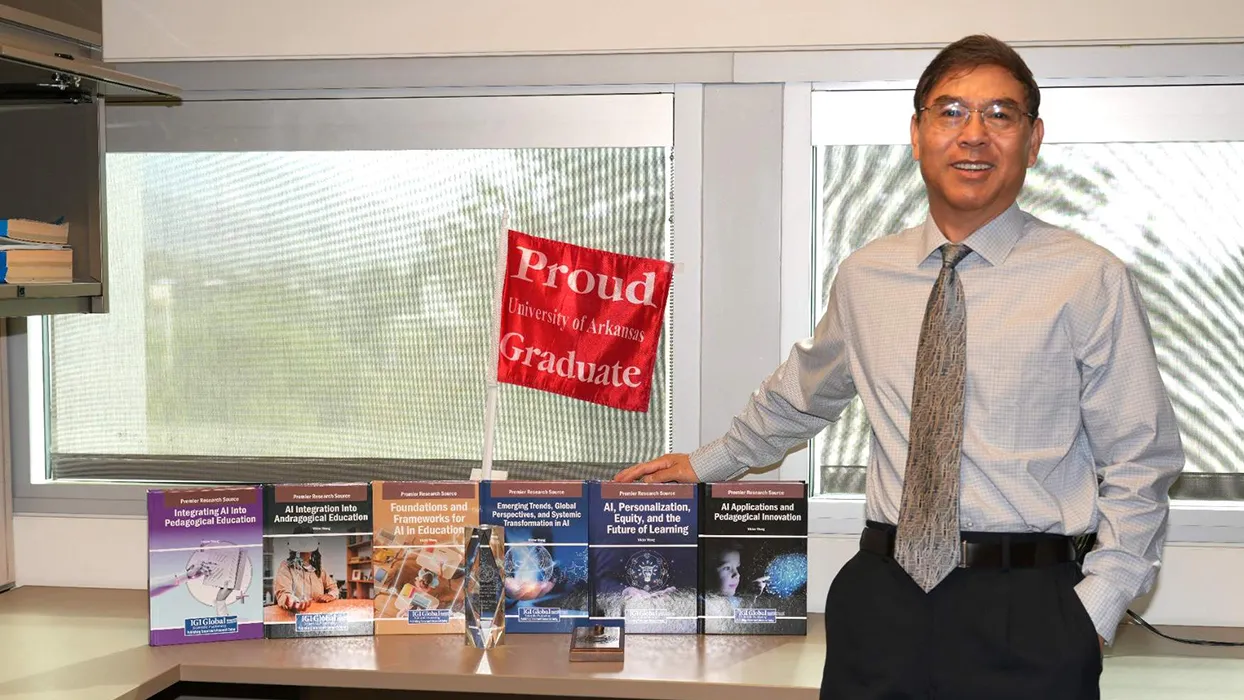
Two new, large-scale reference books edited by Viktor Wang, a professor of education at California State University, San Bernardino, are putting artificial intelligence, ethics and legal education at the center of an urgent global conversation about the future of justice.
The companion volumes — “AI, Ethics, and the Future of Legal Education: Critical Perspectives on Global Practice” and “AI, Ethics, and Legal Education Reform: Global Frameworks and Critical Implications” — lead a growing body of international scholarship examining how artificial intelligence is reshaping courts, classrooms and professional training. Together spanning more than 1,000 pages, the books draw contributors from law schools, universities and judicial systems around the world.
Wang, a professor of educational leadership and technology in CSUSB’s James R. Watson and Judy Rodriguez Watson College of Education, frames the twin works around a central question: What happens when AI becomes embedded in every stage of legal work, from screening frivolous filings to educating future attorneys? The first volume explores AI’s impact on legal processes and global practice, including issues such as platform liability, abuse of process, Title IX disputes and access to justice. The second turns to institutional change, outlining proposed reforms to law school curricula, accreditation standards, clinical education and governance models as AI becomes an unavoidable force in legal training.
Across both volumes, Wang argues that AI can help courts identify abusive litigation while preserving due process, support overburdened legal aid systems, and enhance legal education. But he also warns of risks — including bias, opacity, data ethics concerns and overreliance on automated tools — underscoring the need for transparent, auditable and accountable AI systems.
Wang’s advocacy stems from both professional expertise and personal experience navigating what he describes as a “meritless civil lawsuit.” On the pedagogical side, he has watched his leadership and research students wrestle with questions of ethics, power and institutional accountability in a rapidly changing AI landscape.
He contends that AI-assisted screening tools, used under human oversight, could help courts detect patterns of misuse and protect resources for legitimate cases.
A prolific scholar with more than 260 peer-reviewed publications, Wang has long been recognized for his work in adult and higher education, leadership and andragogy. His edited handbooks and reference texts are widely catalogued in major university libraries, and he has mentored more than 80 doctoral students. His new AI-focused volumes extend that record, drawing connections between ethical technology use, leadership education and global legal reform.
The books also address challenges facing institutions, calling for transparent standards in decision-making, clear documentation, and ethical integration of AI across both accreditation and legal processes. Wang positions the volumes as resources not only for law schools and courts, but also for university programs in leadership, public administration and education, as well as for pro se litigants seeking clearer pathways through the justice system.
Wang said he hopes the books will inform judicial training, inspire curricular adoption and eventually support collaborations that prototype AI tools designed to strengthen both efficiency and equity.
In addition to the new volumes, Wang’s broader body of work continues to elevate CSUSB’s presence in global academic discourse.
Starting in the fall 2025 semester and continuing in the upcoming spring semester is a series of IRA-funded AI workshops for students. The workshops are built on a rigorous academic foundation of six published books — totaling nearly 3,000 pages — on artificial intelligence, pedagogy, equity and educator practice. The series transforms scholarly research into practical, hands-on skills students can use immediately in their coursework.
The workshops are designed to help students integrate AI into the learning process — brainstorming, outlining, studying and research planning — while maintaining authorship, judgment and accountability. Each session emphasizes ethical and responsible AI use, encouraging participants to verify sources, protect privacy and submit work that reflects their own ideas.
Wang was featured on CCTV-America in what is believed to be the first appearance by a CSU faculty member on the international broadcast network. In that interview, recorded during his tenure at Florida Atlantic University, Wang discussed the role of career and technical education (CTE) in workforce development and economic growth — themes consistent with his long-standing leadership in adult education and CTE integration.
With more than 80 books – including 13 published in one year – and hundreds of scholarly publications, Wang remains a prominent voice in educational leadership, ethical technology use and global workforce preparation. His latest contributions position CSUSB at the forefront of international discussions about AI, justice and the future of legal and professional training.